Index Funds vs ETFs: What Is the Difference and Which Is Better?
If you’re looking to invest in the stock market without picking individual stocks, index funds and ETFs are two of the most popular options. Both offer diversification, low costs, and solid long-term returns. But they’re not identical. Here’s the thing: understanding the key differences between index funds vs ETFs could help you make smarter investing decisions based on your goals, budget, and trading habits.
What Are Index Funds and ETFs?
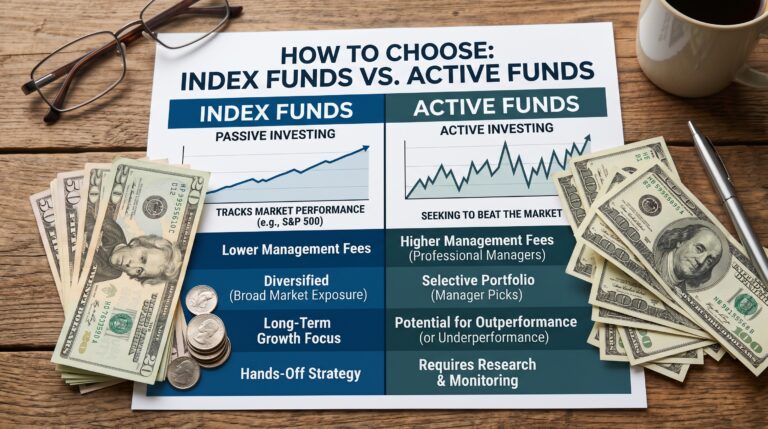
Index funds and ETFs are both types of passively managed investments designed to track a specific market index like the S&P 500 or Nasdaq 100. The main difference? How they’re traded. Index funds are mutual funds that price once per day after markets close. ETFs trade like stocks throughout the trading day.
Real talk: both are excellent choices for most investors. Vanguard’s S&P 500 index fund (VFIAX) and SPDR S&P 500 ETF (SPY) have delivered nearly identical returns over the past decade, averaging about 10.5% annually. But subtle differences matter depending on your situation.
Key Differences Between Index Funds and ETFs
Let’s break down the major distinctions with real numbers:
- Trading flexibility: ETFs can be bought/sold anytime during market hours. Index funds only execute trades at 4pm ET. This matters if you’re an active trader.
- Minimum investments: Many index funds require $1,000-$3,000 minimums (Vanguard’s VFIAX is $3,000). ETFs can be bought for the price of one share (SPY was ~$520 in May 2026).
- Expense ratios: Both are low-cost, but ETFs often win. SPY charges 0.0945%, while VFIAX charges 0.04%. That’s $9.45 vs $4 annually per $10,000 invested.
- Tax efficiency: ETFs typically generate fewer taxable capital gains due to their creation/redemption process.
When Index Funds Might Be Better
Index funds shine for hands-off investors who want to “set and forget.” Here’s why you might prefer them:
1. Automatic investing: You can set up recurring purchases with index funds (great for dollar-cost averaging). Most brokerages don’t allow this with ETFs.
2. Fractional shares: Many index funds let you invest any dollar amount. With ETFs, you typically need to buy whole shares.
3. No bid-ask spreads: Index funds always execute at the day’s closing NAV price. ETF prices fluctuate throughout the day.
When ETFs Might Be Better
ETFs offer advantages for certain investors:
Active traders: If you want to trade during market hours, use limit orders, or employ strategies like options, ETFs are your only choice between these two.
Smaller accounts: With just $500? You can buy one share of many ETFs but might not meet index fund minimums.
Taxable accounts: ETFs’ tax efficiency makes them ideal for brokerage accounts. Vanguard has a patent that makes their index funds equally tax-efficient until at least 2026.
Performance Comparison: Do ETFs or Index Funds Earn More?
Bottom line: performance differences are negligible for most mainstream funds tracking the same index. From 2016-2026:
– Vanguard 500 Index Fund (VFIAX): 10.53% annual return
– SPDR S&P 500 ETF (SPY): 10.51% annual return
The 0.02% difference is rounding error. What matters more is choosing low-cost funds and holding them long-term.
Frequently Asked Questions
Can you lose money in index funds or ETFs?
Yes. While diversified funds are safer than individual stocks, they still carry market risk. During the 2022 bear market, the S&P 500 dropped nearly 20%. But historically, the market has always recovered.
Which has higher fees: ETFs or index funds?
Typically ETFs are slightly cheaper. The average ETF expense ratio is 0.16% vs 0.43% for index mutual funds (2026 data). But some index funds, especially at Vanguard, undercut ETFs.
Should I own both ETFs and index funds?
It’s not necessary, but some investors use index funds in retirement accounts (for automatic investing) and ETFs in taxable accounts (for tax efficiency). Just avoid overlapping holdings.
How much do I need to start investing in ETFs or index funds?
Many brokers now offer $0 minimums and fractional shares. You can start some ETFs with as little as $1. Traditional index funds often require $1,000+ initially.
Ready to put this knowledge into action? Whether you choose index funds or ETFs, the most important step is starting. Open a brokerage account today, set up automatic contributions, and let compound growth work its magic over time. Your future self will thank you.