How to Choose: Index Funds vs Active Funds
Table of Contents
- Understanding Investment Fundamentals: Index Funds vs Active Funds
- The Core Differences: Index Funds Active Funds Under the Microscope
- Performance Tracking: Index Funds Active Funds Historical Data
- Cost Implications: Why Fees Matter for Long-Term Growth
- Risk and Volatility: Comparing Index Funds Active Funds Portfolios
- Tailoring Your Strategy: Index Funds Active Funds for Retirement
- Making Your Decision: A Step-by-Step Action Plan
- Conclusion: Your Long-Term Investing Path
- FAQs About Index Funds vs Active Funds
When planning for long-term growth, understanding the differences between index funds active funds is crucial. Many investors grapple with this choice, seeking the most effective path to wealth accumulation. This guide will clarify the nuances, helping you make an informed decision for your financial future.
Understanding Investment Fundamentals: Index Funds vs Active Funds
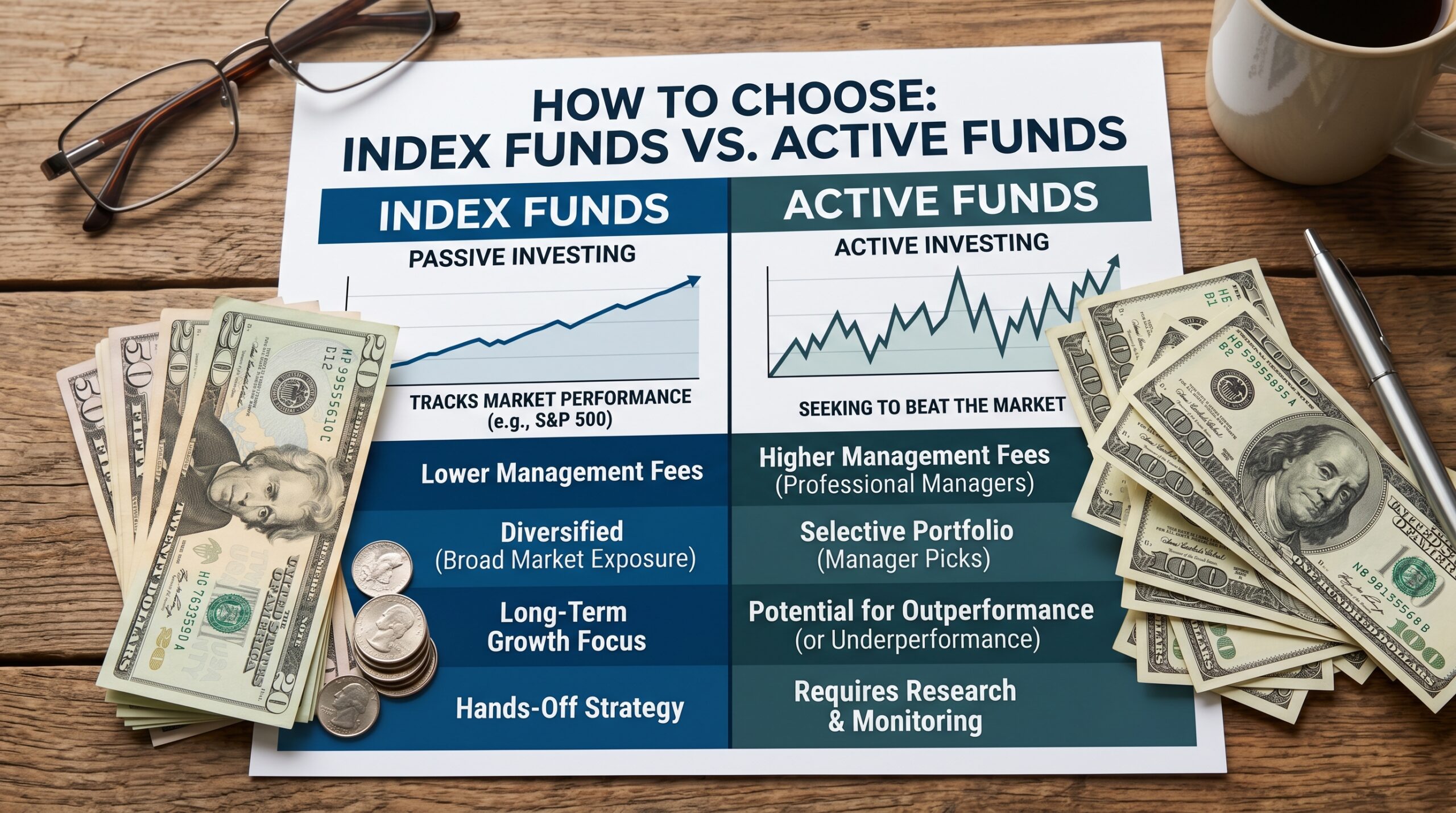
Investing for long-term growth requires careful consideration of various investment vehicles. Two prominent options are index funds and actively managed funds. Furthermore, both aim to generate returns, yet their approaches differ significantly. Index funds essentially mirror a specific market index, like the S&P 500. This passive strategy seeks to match the market’s performance, not beat it. Conversely, active funds rely on skilled fund managers to pick stocks, aiming to outperform the market. Therefore, the distinction between index funds active funds impacts returns, risk, and costs.
Defining Index Funds: Passive Investing Explained
An index fund is a type of mutual fund or exchange-traded fund (ETF) with a portfolio constructed to match or track the components of a market index. Consequently, this passive approach eliminates the need for extensive research and frequent trading decisions. For instance, an S&P 500 index fund would hold stocks in the same proportion as the S&P 500 index itself. This strategy boasts lower fees because it requires less active management. Indeed, many new investors find index funds appealing for their simplicity and broad market exposure.
Defining Active Funds: The Managed Approach
Active funds, alternatively, are managed by professional fund managers. These managers conduct in-depth research, analyze market trends, and make strategic investment decisions. Their goal is to identify undervalued assets or capitalize on market inefficiencies to generate returns exceeding the performance of a benchmark index. For example, a manager might choose specific tech stocks based on proprietary analysis. This hands-on approach often results in higher operating expenses, mainly due to management fees and trading costs. The success of active funds hinges on the manager’s skill, highlighting a key difference between index funds active funds.
The Core Differences: Index Funds Active Funds Under the Microscope
The operational mechanisms of index funds active funds present distinct characteristics for investors. Understanding these fundamental differences is key to aligning your investment choice with your financial objectives. One major difference lies in their investment philosophy. Index funds follow a systematic, rule-based approach, while active funds embrace discretion and human expertise. Therefore, your preference for either passive replication or expert selection will guide your decision.
Investment Philosophy and Strategy
Index funds embody the philosophy that markets are efficient, or at least difficult to consistently beat. They accept market returns. The strategy is to buy and hold a diversified portfolio that mirrors a chosen index. This often leads to broad market exposure. Active funds, however, believe that market inefficiencies exist and can be exploited. Their strategy involves active security selection, market timing, and asset allocation adjustments. This proactive stance aims for alpha, which is the excess return above the benchmark. This contrast is central to any discussion of index funds active funds.
Transparency and Predictability
Index funds offer high transparency; investors know exactly what assets they hold by simply looking at the index components. Their performance is generally predictable, closely tracking the benchmark. This clarity provides a sense of security for many. Active funds, conversely, are less transparent in their day-to-day holdings and trading decisions. Managers might change their portfolio frequently, making it harder for investors to predict specific holdings or short-term performance. This difference in transparency is a significant factor when contemplating index funds active funds.
Performance Tracking: Index Funds Active Funds Historical Data
Examining historical performance is crucial when comparing index funds active funds. While past performance does not guarantee future results, it offers valuable insights. Over extended periods, many studies show that index funds often outperform a significant percentage of actively managed funds, especially after fees. This trend provides a strong argument for passive investing. Investors considering free financial calculators can model these historical returns.
Long-Term Performance Trends
Data consistently indicates that a majority of actively managed funds fail to beat their benchmark index over the long run. For instance, reports often show that over a 10-year period, a substantial percentage of large-cap active funds underperform the S&P 500 index. This underperformance is often attributed to higher fees and the difficulty of consistently picking winning stocks. Thus, when looking at long-term growth, the consistent, albeit market-level, returns of index funds can be very compelling. This sustained outperformance of indexes over active funds strengthens the case for passive investing.
The Challenge of Beating the Market
Consistently beating the market is an exceptionally difficult endeavor. Fund managers face intense competition, access to similar information, and varying market conditions. Transaction costs and behavioral biases also play significant roles. Even highly skilled managers struggle to outperform benchmarks year after year. Consequently, for many investors, simply matching the market performance through index funds is a more reliable strategy for long-term growth. This difficulty is a primary reason why many investors ultimately choose index funds active funds to mirror the broader market.
Cost Implications: Why Fees Matter for Long-Term Growth
Costs are a major differentiator between index funds active funds and significantly impact long-term returns. Understanding these fees is critical for maximizing your investment growth. Over decades, even seemingly small differences in expense ratios can lead to substantial disparities in your final portfolio value. Therefore, cost-efficiency should be a primary consideration.
Comparative Fee Structures
Index funds typically have very low expense ratios, often ranging from 0.03% to 0.20% per year. This is because they do not require extensive research or active trading. Their strategy is inherently cost-efficient. Active funds, conversely, incur higher fees, commonly between 0.50% and 2.00% or even more. These higher fees compensate for manager salaries, analyst research, trading commissions, and administrative overhead. The difference in these fees directly affects net returns for index funds active funds.
- Index Fund Fees:
- Expense Ratio: 0.03% – 0.20% (Commonly)
- Trading Costs: Very Low (Infrequent rebalancing)
- Management Fees: Minimal
- Active Fund Fees:
- Expense Ratio: 0.50% – 2.00%+ (Commonly)
- Trading Costs: Higher (Frequent buying/selling)
- Management Fees: Substantial (Manager salaries, research teams)
- Performance Fees: Sometimes an additional layer if the fund outperforms
The Impact of Expense Ratios Over Time
The compounding effect of fees is a powerful concept. A 1% difference in expense ratio might seem small annually. However, over 30 or 40 years, that 1% can erode a significant portion of your potential gains. For example, an initial $10,000 investment growing at 7% annually with a 0.10% fee will yield substantially more than the same investment with a 1.50% fee. This is a critical factor, especially when considering index funds vs active funds for retirement planning. Minimizing costs is a core principle for long-term financial success.
Risk and Volatility: Comparing Index Funds Active Funds Portfolios
Assessing risk and volatility is another essential step when deciding between index funds active funds. While both investment types carry market risk, their diversification levels and management styles can influence their specific risk profiles. Your comfort with risk should play a key role in your selection.
Diversification and Market Exposure
Index funds offer inherent diversification because they track a broad market index. An S&P 500 index fund, for instance, provides exposure to 500 different companies across various sectors. This broad diversification helps to mitigate company-specific risk. Active funds sometimes concentrate investments in fewer companies or specific sectors, which can increase their idiosyncratic risk. While this can lead to higher returns if the manager is correct, it also amplifies the potential for losses. Therefore, understanding the diversification of index funds active funds is vital.
Volatility and Downside Protection
Index funds generally exhibit market-level volatility. They will rise and fall with the overall market. They do not offer downside protection beyond what the market itself provides. Active funds, theoretically, could offer some downside protection if a skilled manager moves to cash or invests in less volatile assets during market downturns. However, this is not always successful, and many active funds still experience significant drawdowns. Thus, for most investors, the comprehensive diversification of index funds often provides a more predictable volatility profile compared to the varied outcomes of index funds active funds.
Tailoring Your Strategy: Index Funds Active Funds for Retirement
Choosing between index funds active funds for retirement is a decision with profound long-term implications. Your retirement planning strategy should align with your risk tolerance, time horizon, and financial goals. Many financial experts endorse a diversified approach, often favoring index funds for a substantial portion of a retirement portfolio.
Long-Term Growth and Retirement Goals
For retirement, the consistent, market-matching returns and low costs of index funds are highly attractive. Over decades, compounding returns on a broadly diversified index fund can lead to significant wealth accumulation. They remove the stress of trying to pick winning managers. This makes Finances News often recommend them for long-term investors. When considering index funds vs active funds for retirement, the predictability of index funds can be a substantial benefit.
Combining Strategies: A Hybrid Approach
Some investors opt for a hybrid approach, combining the best aspects of both. They might allocate a large portion of their portfolio to low-cost index funds for core market exposure. Then, they might use a smaller percentage for actively managed funds in specific sectors or strategies where they believe active management can truly add value. This balanced approach aims to capture market returns while also seeking alpha in targeted areas. This consideration is key when constructing a robust plan for index funds active funds for retirement.
| Feature | Index Funds | Active Funds |
|---|---|---|
| Investment Goal | Match Market Performance | Outperform Market (Alpha) |
| Management Style | Passive, Rules-Based | Active, Discretionary |
| Expense Ratios | Very Low (e.g., 0.03%-0.20%) | Higher (e.g., 0.50%-2.00%+) |
| Diversification | Broad Market Exposure | Potentially Concentrated |
| Risk Profile | Market Risk Only | Market + Manager Risk |
| Transparency | High – Holdings are Public | Lower – Holdings Change |
| Historical Performance | Often Outperform Actively Managed Funds over Long Term (Post-Fee) | Majority Underperform Benchmark over Long Term (Post-Fee) |
| Tax Efficiency | Generally Higher (Lower Turnover) | Generally Lower (Higher Turnover) |
| Ideal Investor | Long-Term, Cost-Conscious, Believes in Market Efficiency | Believes in Manager Skill, Willing to Pay for Potential Alpha |
Making Your Decision: A Step-by-Step Action Plan
Choosing between index funds active funds requires a structured approach. This action plan will guide you through the decision-making process, ensuring your investment choices align with your personal circumstances. By following these steps, you can create a robust investment strategy. You might also want to consult with a financial advisor for personalized advice during these steps.
- Assess Your Investment Goals: Clearly define what you want to achieve. Are you saving for retirement, a down payment, or another long-term objective? Your goals will significantly influence your strategy for index funds active funds.
- Determine Your Risk Tolerance: Understand how much volatility you can comfortably handle. Passive index funds track the market; active funds carry manager risk. This assessment informs your choice toward either index funds active funds.
- Evaluate Your Time Horizon: Longer time horizons generally allow for more risk and potentially higher returns from diversified investments. Short-term goals might require more conservative approaches.
- Research Expense Ratios: Compare the fees of various funds diligently. Remember, lower expense ratios can significantly boost long-term returns, especially when considering index funds vs active funds for retirement.
- Consider Diversification Needs: Ensure your chosen funds provide adequate diversification. Index funds inherently offer broad diversification, while active funds may require more careful selection to achieve it.
- Monitor and Rebalance (if necessary): Regardless of your choice, regularly review your portfolio. Rebalance to maintain your desired asset allocation. This is a crucial step for long-term success.
Conclusion: Your Long-Term Investing Path
Ultimately, the decision between index funds active funds depends on your individual investment philosophy, risk tolerance, and financial goals. For many long-term investors, particularly those planning for retirement, the low costs, broad diversification, and consistent market-matching performance of index funds make them an incredibly compelling choice. Historically, they have often outperformed their actively managed counterparts after fees. However, active funds can offer potential benefits for those who believe in manager skill and are willing to pay for it. Consider your unique situation for car and auto finance guides to everyday investments. Carefully weighing the pros and cons of index funds active funds will help you construct a portfolio designed for sustainable long-term growth.
What are the main differences between index funds and active funds?
The main differences lie in their management style, fees, and investment goals. Index funds passively track a market index with low fees, aiming to match market performance. Active funds are managed by professionals who actively pick stocks to beat the market, typically incurring higher fees. This distinction is central to understanding index funds active funds.
Which typically performs better over the long term, index funds or active funds?
Historically, a significant majority of index funds have outperformed actively managed funds over the long term, especially after accounting for fees. This is due to the difficulty of consistently beating the market and the compounding effect of lower costs unique to index funds active funds.
Are index funds suitable for retirement planning?
Yes, index funds are highly suitable for retirement planning. Their low costs, broad diversification, and consistent market returns make them an excellent choice for long-term wealth accumulation. Many financial advisors recommend using index funds vs active funds for retirement portfolios.
How do fees impact the returns of index funds vs active funds?
Fees have a substantial impact on returns. Active funds’ higher expense ratios can significantly erode long-term gains, even if they occasionally outperform before fees. Index funds’ low fees allow more of your investment to compound, highlighting a key advantage of index funds active funds.
Can I combine index funds and active funds in my portfolio?
Yes, adopting a hybrid approach is a common strategy. You can use low-cost index funds for core market exposure and allocate a smaller portion to active funds for specific opportunities or strategies. This allows you to benefit from both index funds active funds.