Tracking Money, Markets, and the World that Moves Them

Tracking Money, Markets, and the World that Moves Them
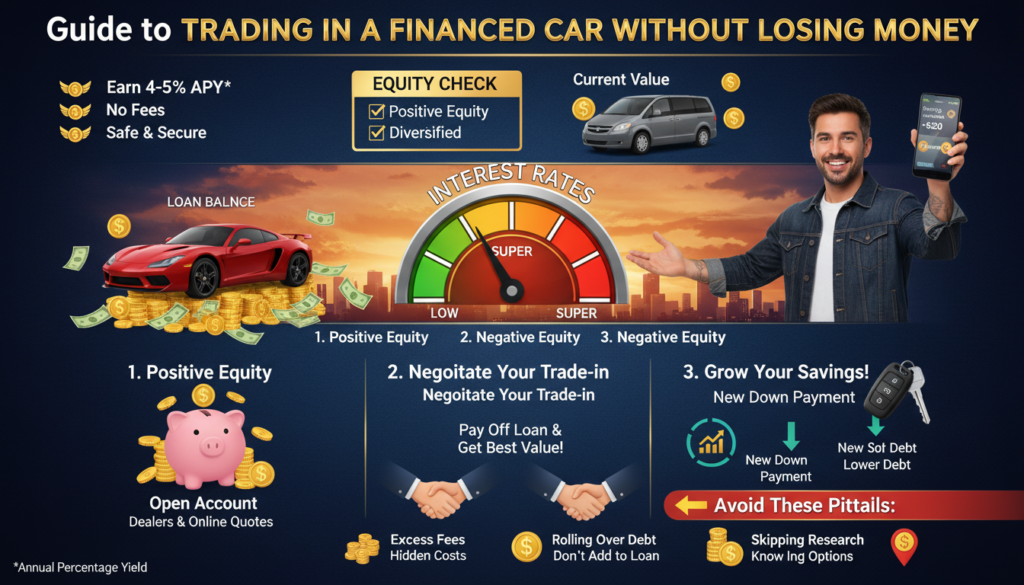
Did you know that nearly 33% of car buyers in the United States are underwater on their auto loans, owing more than their vehicles are worth? This startling statistic reveals a critical challenge facing millions of Americans who need to upgrade or change their vehicles before paying off their existing loans. Trading in a financed car can seem like a financial minefield, but with the right strategy and understanding of automotive economics, you can navigate this process without suffering significant financial losses. Whether you’re looking to downsize for better fuel efficiency, upgrade to accommodate a growing family, or simply escape a problematic vehicle, understanding the mechanics of trading in a financed car is essential for protecting your financial wellbeing and making informed decisions in today’s complex automotive marketplace.
Before diving into the trading process, it’s crucial to understand several foundational terms that will guide your decision-making:
Negative Equity (Being Underwater): This occurs when your car’s current market value is less than the remaining loan balance. For example, if you owe $18,000 but your car is worth only $14,000, you have $4,000 in negative equity.
Positive Equity: The opposite scenario, where your vehicle’s value exceeds what you owe. This favorable position gives you leverage and potentially money to put toward your next vehicle.
Loan-to-Value Ratio (LTV): This percentage represents your loan balance divided by the car’s current value. Financial experts recommend maintaining an LTV below 125% to avoid being significantly underwater.
Payoff Amount: The total sum required to completely pay off your auto loan, which may include the principal balance plus any remaining interest or fees.
Trade-In Value: The amount a dealership offers for your current vehicle, typically lower than private-party value but offering convenience and potential tax benefits.
Understanding these concepts creates the foundation for making strategic decisions that protect your financial interests throughout the trading process.
The automotive market has experienced unprecedented volatility in recent years, with used car prices surging 40% between 2020 and 2022 before moderating in 2023-2024. Currently, the market is experiencing normalization, with used vehicle values declining approximately 8-12% annually as supply chains recover and inventory levels stabilize.
Interest rates on auto loans have climbed significantly, with average rates for used cars reaching 8-11% compared to just 4-5% three years ago. This economic shift fundamentally changes the calculation for trading in a financed car, as higher borrowing costs can quickly erode any equity gains.
The electric vehicle (EV) revolution is also creating market disruptions, with traditional internal combustion engine vehicles potentially facing accelerated depreciation as consumer preferences shift. Some analysts project that certain gas-powered models could depreciate 15-20% faster than historical averages over the next five years.
Start by researching your vehicle’s current market value using multiple reputable sources. Check Kelley Blue Book (KBB), Edmunds, and NADA Guides to establish a realistic value range. These platforms use vast databases of actual sales transactions to provide accurate valuations.
Next, contact your lender directly to obtain your precise payoff amount. This figure changes daily due to interest accrual, so request the payoff amount effective for your anticipated trade-in date. Don’t rely on your monthly statement, as it typically doesn’t reflect the total payoff figure.
Research current interest rates from multiple lenders, including credit unions, banks, and online lenders. Credit unions often offer rates 1-2 percentage points lower than traditional dealership financing, potentially saving thousands over the loan term.
Finally, monitor automotive market trends through resources like Cox Automotive, Manheim Market Report, and automotive industry publications to understand whether vehicle values are trending upward or downward in your segment.
Calculate your equity position by subtracting your payoff amount from your vehicle’s current market value. If you have positive equity, you’re in a strong negotiating position. If underwater, determine how much negative equity you’re carrying.
Consider the total cost of trading versus keeping your current vehicle. Factor in remaining loan payments, expected maintenance costs, and the depreciation trajectory of your current car. Sometimes, the most financially prudent decision is continuing with your current vehicle despite the desire to trade.
Evaluate whether paying down your loan before trading makes financial sense. If you’re slightly underwater, investing additional payments to reach positive equity could save substantially on your next loan by avoiding rolled-over negative equity.
Compare the tax implications of trading versus selling privately. In many states, you only pay sales tax on the difference between the new car’s price and your trade-in value, potentially saving hundreds or thousands of dollars compared to selling privately and buying separately.
Recent automotive financing data reveals critical insights for those considering trading in financed vehicles:
The average auto loan term has stretched to 68 months for new cars and 65 months for used vehicles, up from 60 months a decade ago, increasing the period consumers remain underwater.
Approximately 18% of trade-ins currently carry negative equity, with an average deficit of $6,000 per transaction, according to Edmunds data.
Vehicles depreciate approximately 20% in the first year and 15% annually for the next four years, making the first three years particularly risky for trading with remaining loan balances.
The average monthly payment for financed used vehicles reached $528 in 2024, up 25% from 2020 levels, largely driven by higher interest rates and increased vehicle prices.
Credit score significantly impacts auto loan rates, with excellent credit (750+) qualifying for rates 4-6 percentage points lower than fair credit (620-679), translating to approximately $50-75 monthly savings on a $25,000 loan.
These data points underscore the importance of strategic timing and careful financial planning when trading in a financed vehicle.
If you’re underwater on your loan, consider these alternatives to traditional trading:
Gap Coverage: If you haven’t already, purchasing gap insurance protects you if your car is totaled or stolen, covering the difference between insurance payout and loan balance.
Loan Acceleration: Make extra principal payments to build equity faster. Even an additional $100 monthly can reduce your loan balance significantly over 12-18 months, potentially moving you from negative to positive equity.
Lease Assumption: Some manufacturers allow lease transfers, which might be an option if you’re in a lease rather than traditional financing.
Private Sale with Loan Payoff: Selling privately typically yields 15-25% more than trade-in value. Work with your lender to facilitate the transaction, where the buyer pays the lender directly for the payoff amount.
Delay and Maintain: If feasible, keeping your current vehicle until you reach positive equity or pay off the loan entirely eliminates the risk of compounding debt through negative equity rollover.
Refinancing Strategy: If your credit has improved since your original loan, refinancing to a lower rate accelerates equity building and reduces total interest paid.
Optimize Your Trade-In Timing: Trade-in values fluctuate seasonally, with convertibles commanding premium prices in spring and SUVs performing better in fall. Time your trade accordingly for maximum value.
Prepare Your Vehicle: Invest $150-300 in professional detailing, minor repairs, and maintenance records organization. Presentation can increase trade-in offers by 5-10%, potentially adding hundreds of dollars.
Obtain Multiple Offers: Don’t accept the first trade-in offer. Visit at least three dealerships, and consider services like CarMax, Carvana, and Vroom, which often provide competitive offers with minimal negotiation.
Negotiate Separately: Never disclose your trade-in until you’ve negotiated the new vehicle price. Dealers often manipulate numbers between trade value and purchase price, obscuring the true deal economics.
Consider Certified Pre-Owned (CPO): When trading in a financed car, purchasing a CPO vehicle instead of new can significantly reduce depreciation risk while providing warranty protection and reliability.
Structure Your New Loan Wisely: Aim for the shortest loan term you can afford, ideally 48-60 months, to build equity faster and minimize interest costs. Consider putting down at least 10-20% to avoid immediate negative equity.
Understand the True Cost: Calculate the all-in expense including rolled-over negative equity, new loan interest, insurance cost changes, and projected depreciation before committing to any trade.
Rolling Over Excessive Negative Equity: Adding $5,000-10,000 in negative equity to a new loan creates a dangerous debt spiral. You’ll be severely underwater immediately and may struggle to escape for years.
Extending Loan Terms to Lower Payments: While 72- or 84-month loans reduce monthly payments, they dramatically increase total interest paid and extend the period of negative equity, often exceeding the vehicle’s useful life.
Ignoring Total Cost of Ownership: Focusing solely on monthly payments rather than total expenditure (including interest, insurance, maintenance, and depreciation) leads to poor financial decisions.
Trading Too Frequently: Each trade within the first 3-4 years of ownership typically locks in maximum depreciation loss. Serial traders often perpetuate negative equity cycles indefinitely.
Accepting Dealer Financing Without Comparison: Dealer-arranged financing can include marked-up interest rates. Always secure pre-approval from outside lenders for negotiating leverage.
Neglecting the Equity Timeline: Failing to understand when you’ll reach positive equity can result in trading at the worst possible financial moment.
Emotional Decision-Making: Trading vehicles based on wants rather than needs, especially while underwater, compounds financial stress and limits future flexibility.
Overlooking Tax Implications: In states with trade-in tax advantages, private sales might net less despite higher gross proceeds.
Create a Vehicle Replacement Fund: Begin saving monthly for your next vehicle immediately after purchasing your current one. Target $150-250 monthly to accumulate a substantial down payment, reducing future loan amounts.
Maintain Comprehensive Records: Document all maintenance, repairs, and upgrades. Well-documented service history can increase trade-in value by $300-800 and facilitates smoother transactions.
Monitor Your Loan Progress: Check your loan balance and vehicle value quarterly. Understanding your equity position enables strategic timing and prevents surprises when you’re ready to trade.
Build and Protect Your Credit: Your credit score dramatically impacts auto loan rates. Pay all bills on time, maintain low credit utilization, and avoid new credit inquiries before car shopping to optimize your borrowing power.
Establish a Trading Threshold: Decide in advance you’ll only trade when you have at least $1,000-2,000 in positive equity, providing a buffer and ensuring you’re not perpetuating debt cycles.
Consider Total Transportation Budgeting: Financial experts recommend limiting all transportation costs (payments, insurance, fuel, maintenance) to 15-20% of gross income. Exceeding this threshold strains overall financial health.
Plan for Depreciation: Accept that depreciation is inevitable and factor it into your vehicle ownership strategy. Choose vehicles with strong resale value and avoid excessive customization that limits market appeal.
Leverage Technology: Use apps and tools that track vehicle values, loan balances, and optimal trading windows, taking emotion out of financial decisions.
Trading in a financed car without losing money requires strategic planning, market awareness, and disciplined financial management. By understanding your equity position, timing the market effectively, and avoiding common pitfalls like rolling over excessive negative equity or extending loan terms unnecessarily, you can navigate vehicle trades while protecting your financial interests. Remember that the best trade is often the one you delay until reaching positive equity, allowing time and additional payments to work in your favor. The automotive market’s current normalization presents opportunities for savvy consumers who approach trading with knowledge and patience. Whether you ultimately decide to trade now or wait, the principles outlined here will help you make informed decisions aligned with your broader financial goals.
Ready to take control of your automotive finances? Explore our comprehensive guides on auto loan refinancing, vehicle depreciation strategies, and smart car-buying techniques to further enhance your financial literacy and decision-making capabilities.
A: Yes, you can trade in a car with negative equity, but the remaining balance will be added to your new loan. For example, if you owe $20,000 but your car is worth $16,000, the $4,000 difference gets rolled into your next vehicle’s financing. This creates an immediate negative equity situation on your new loan, so proceed cautiously and consider alternatives like paying down the loan first.
A: Trading in itself doesn’t directly impact your credit score, but the process involves several factors that do. Paying off your existing loan (even through trade-in) is positive, but applying for new financing triggers a hard inquiry (typically 5-10 point temporary decrease). Your credit utilization and payment history on the new loan will then affect your ongoing score.
A: Private sale values typically exceed trade-in offers by 15-25% because you’re selling directly to an end user rather than a dealer who needs profit margin for resale. However, trade-ins offer convenience, potential tax savings (in most states, you only pay sales tax on the difference between new car price and trade value), and eliminate the hassle of marketing, showing, and coordinating with your lender for private sales.
A: The optimal time is when you have positive equity, ideally at least $1,000-2,000 above your loan balance. This typically occurs after 3-4 years on a standard 60-month loan with reasonable down payment. Additionally, consider seasonal factors—convertibles bring premium prices in spring, while SUVs and trucks command higher values in fall and winter.
A: No, negotiate the new vehicle purchase price first as if you’re not trading anything. Once you’ve agreed on the purchase price, then introduce your trade-in and negotiate that value separately. This prevents dealers from manipulating figures between the two transactions, ensuring you get fair value on both ends of the deal.
A: Call your lender to get your exact payoff amount, then check your vehicle’s current market value using Kelley Blue Book, Edmunds, or NADA Guides. Subtract the payoff amount from the market value. A positive result means positive equity; a negative result means you’re underwater. For accuracy, use the “trade-in” value rather than private party or retail values when comparing to dealer trade-in scenarios.
A: Rolling negative equity into a new loan increases the total amount financed, which raises your monthly payment, extends your underwater period, and increases total interest paid over the loan life. For example, rolling $5,000 negative equity into a new $25,000 car loan (now $30,000 total) at 8% interest over 60 months adds approximately $100 to your monthly payment and $6,000 in additional interest.
A: Yes, several alternatives exist. You can sell privately for higher value, though this requires coordinating payoff with your lender. Services like CarMax, Carvana, and Vroom offer quick purchases, often at competitive prices. Some dealerships offer “wholesaler” programs where they’ll buy your car even if you’re not purchasing from them. Compare all options to maximize value while considering convenience factors.